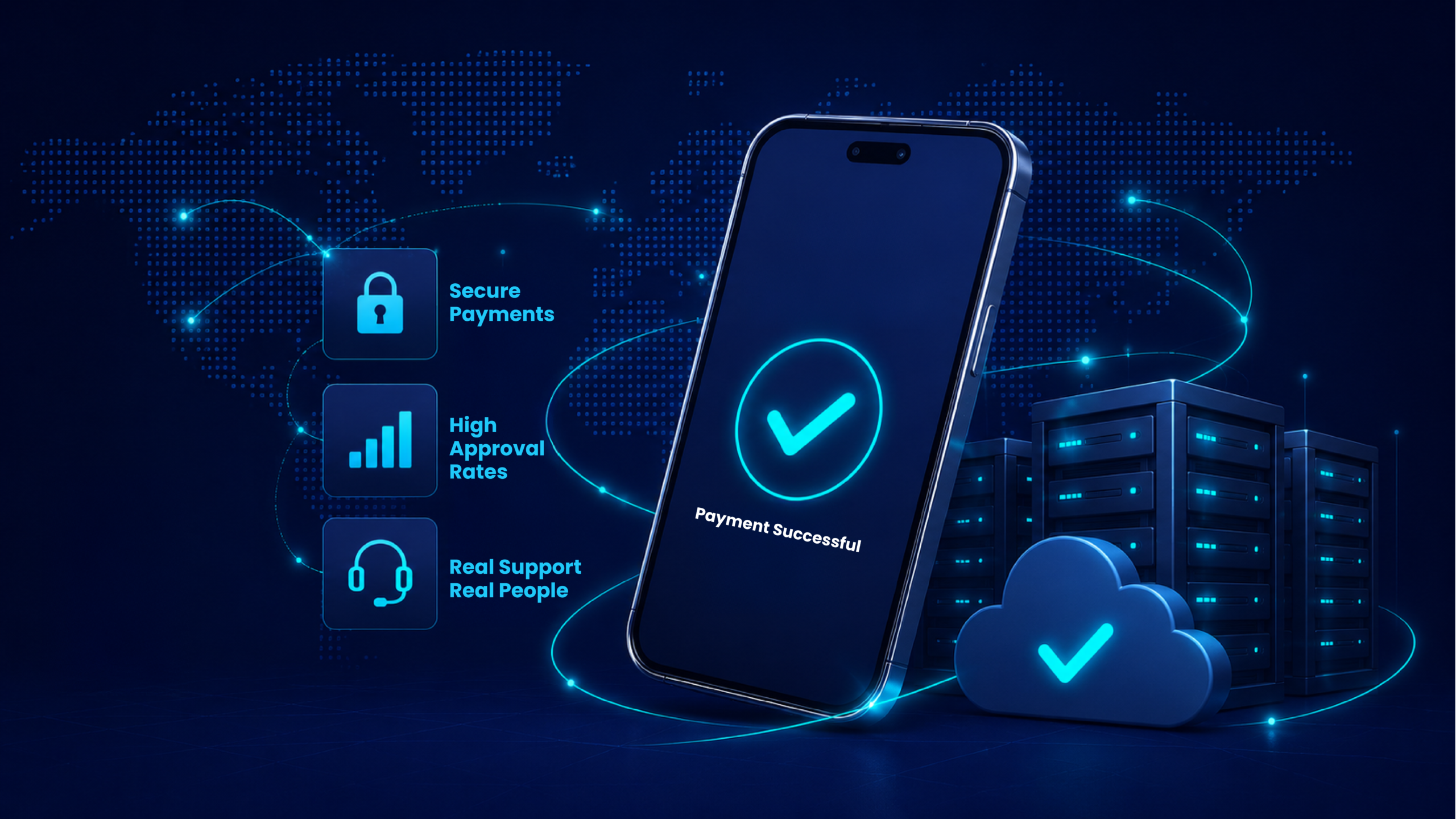
5 Questions every merchant should ask when choosing a payment processor
August 4, 2026
Starting to sell online or thinking of switching providers? Here are five questions to help you compare pricing, flexibility, payment performance and support.
Choosing a payment processor can seem complicated, especially when you are preparing to accept online payments for the first time.
You need a payment provider that allows customers to pay easily, protects transactions and transfers funds to your business without unnecessary delays. You also need to understand what the service will actually cost and how quickly you can start using it.
The same questions matter when you already accept online payments but are considering switching providers.
High fees, limited payment methods, slow payouts, rigid integrations or poor support may indicate that your current setup no longer fits your business.
The lowest advertised rate does not always mean the lowest overall cost. A long list of payment methods is not useful if the checkout is difficult to integrate. Fast technology will not help much if onboarding takes weeks or support is unavailable when something goes wrong.
Before choosing your first payment processor or replacing your current one, ask these five practical questions.
1. What will payment processing really cost?
Payment processing prices can look simple at first. The final cost is often more complicated.
Some providers advertise one processing percentage but charge separately for interchange, card scheme fees, refunds, chargebacks, payouts, currency conversion or additional services. This can make it difficult to estimate the real cost of accepting online payments.
Ask the provider to explain exactly what is included in the price.
You will commonly come across two pricing structures: blended and non-blended pricing.
Blended pricing
Blended pricing combines the main processing costs into one fixed or simplified rate. This may include the processor’s fee, interchange and card scheme fees.
The main advantage is predictability. Merchants can more easily understand what they will pay for each transaction without calculating several separate charges.
This can be particularly useful for first-time online sellers and smaller businesses that want straightforward pricing and easier cost forecasting.
Non-blended pricing
Non-blended pricing, often described as interchange-plus or IC++ pricing, separates the different parts of the transaction cost.
The merchant pays the applicable interchange fee, card scheme fee and processor markup separately. The final cost may vary depending on the card type, issuing country, transaction channel and other factors.
This structure provides more detail and may be suitable for businesses with higher transaction volumes or teams that want to analyse payment costs more closely. However, monthly costs can be harder to predict.
Neither model is automatically better for every merchant. What matters is whether you understand the total price and can compare providers on a like-for-like basis.
An all-inclusive fee structure can reduce the work involved in estimating changing interchange and scheme fees. It gives merchants one clear rate for the main processing costs and makes budgeting easier.
Before signing an agreement, ask:
- Is the pricing blended or non-blended?
- Are interchange and card scheme fees included?
- Are there setup, monthly or minimum-volume fees?
- How are refunds and chargebacks priced?
- Do payouts carry an additional fee?
- Are international cards or currencies priced differently?
- Are additional payment methods charged separately?
- Is better pricing available as transaction volume increases?
If you are switching providers, compare several months of actual payment statements rather than looking only at the advertised transaction rate. Include all processing, payout, refund and service charges in the comparison.
Price should also be considered alongside performance. A slightly lower fee may not save money if the provider has weaker approval rates, fewer relevant payment methods or slow support that affects sales.
The right question is not simply, “What is your transaction fee?” It is: “What will I pay in total, and what is included in that price?”
2. How does the provider protect payments and support approval rates?
Security and compliance are fundamental when accepting online payments.
Your payment processor should operate in line with the regulatory and security requirements that apply to its services and markets. It should clearly explain how payment data is protected, how transactions are monitored and how suspicious activity is handled.
Fraud prevention, however, should not create unnecessary friction for every legitimate customer.
Modern fraud detection can assess factors such as transaction value, customer behaviour, location, device information and previous payment activity. The system can then apply the appropriate level of authentication based on the risk of the transaction.
Dynamic 3D Secure processing, for example, can apply stronger authentication when a transaction presents more risk while allowing eligible lower-risk payments to move through a smoother flow. This balance matters.
Fraud rules that are too strict can block genuine customers and reduce approval rates. Rules that are too relaxed can increase fraud, disputes and chargebacks.
Ask potential providers:
- Which fraud detection tools are included?
- Does the solution support dynamic 3D Secure processing?
- Can fraud rules be adapted to your business model?
- How are suspicious transactions identified?
- How does the provider work to reduce false declines?
- What support is available for chargebacks and disputes?
- Can the provider help analyse and improve approval rates?
- Which security and compliance standards does the provider follow?
Approval rates should always be reviewed in context. They can be affected by the customer’s location, card type, issuing bank, authentication method, transaction data and how the payment is routed.
Be cautious when a provider presents one general approval-rate figure without explaining what it represents. A reliable payment provider should help you understand why payments are being approved or declined and identify practical ways to improve performance without weakening security.
3. How quickly can you integrate and start accepting payments?
A payment solution should work with your existing technology without creating an unnecessarily long or complicated setup.
When asking about integration speed, look beyond the technical connection.
The relevant timeline starts when you submit your application and ends when you successfully accept your first live payment.
Technical integration may only be one part of the process. Merchant verification, compliance checks, contract approval, account configuration, testing and activation can also affect how quickly you go live.
Ask the provider to outline the complete onboarding process and identify what will be required from your side.
Hosted payment page
For many first-time online sellers, a hosted payment page can provide the fastest route to accepting payments.
Customers complete their payment through a secure checkout page operated by the payment provider. This can reduce the amount of technical development required and limit the need for the merchant to handle sensitive payment information directly.
The hosted page should still feel connected to the rest of your online store.
Ask whether you can customize:
- Your logo
- Brand colours
- Fonts
- Languages
- Checkout fields
- Available payment methods
- Confirmation messages
- Customer redirects
A consistent checkout experience helps reassure customers that they are still purchasing from the same business.
Plugins and ready-made integrations
Merchants using common e-commerce platforms may be able to connect through an existing plugin.
A ready-made integration can reduce development work, but you should still check:
- Whether the plugin supports your current platform version
- How regularly it is maintained
- Which payment methods are available
- Whether technical documentation is provided
- Who is responsible for support and updates
API integration
Merchants with more complex requirements may prefer an API integration.
An API offers greater control over the payment experience and allows the checkout flow to be built more directly into a website, application or platform. It may, however, require more development, testing and ongoing technical maintenance.
The provider should support the integration approach that fits your business today while leaving room for future development.
Ask:
- What is the expected time from application to the first live payment?
- Which onboarding and verification steps are required?
- What documents will you need to provide?
- Is a hosted payment page or ready-made plugin available?
- How much development and testing will be required?
- Are the APIs clearly documented?
- Is technical support available during integration?
- Can you test the payment flow before going live?
- Can additional payment methods be added later?
- Can the integration support future business models such as subscriptions or marketplaces?
For merchants switching providers, migration support is particularly important.
Ask whether the new payment setup can be configured and tested while the existing processor remains active. This can reduce the risk of checkout interruptions and lost sales during the transition.
You should also clarify:
- Whether the provider has experience managing processor migrations
- How existing payment flows will be replaced
- Whether stored payment credentials can be migrated, where permitted
- How refunds for transactions processed by the previous provider will be managed
- Whether a fallback plan is available if problems occur during launch
A fast technical integration means little if onboarding takes several weeks or support is unavailable during testing.
The provider should be able to explain the full process, the responsibilities on both sides and the factors that could delay activation.
The right solution should help you start accepting payments quickly while remaining flexible enough to support what comes next.
4. Which payment methods and markets can the provider support?
Customers do not all prefer to pay in the same way.
Cards remain important, but many shoppers also expect digital wallets, local payment methods and Account-to-Account payments.
A strong payment setup may include:
- Credit and debit cards
- Apple Pay and Google Pay
- Local or regional payment methods
- Account-to-Account (A2A) payments
- Bank-based payment options
- Payment links
- Recurring payments, where required.
The right combination depends on the countries you sell in, the customers you serve and the products or services you offer.
Offering too few payment methods can create friction at checkout. A customer may be ready to buy but leave because their preferred option is unavailable.
At the same time, adding every possible payment method without considering customer demand can make the checkout unnecessarily complicated.
Your payment provider should help you understand which options are most relevant for each market.
Future expansion should also be considered from the beginning.
A provider that works well in your home market may not support the currencies, local payment preferences or banking connections needed in another country. Changing the entire payment setup each time you enter a new market can slow growth and add unnecessary costs.
Ask:
- Which cards, wallets and Account-to-Account (A2A) payment methods are supported?
- Which methods are available in each target market?
- Can payment methods be added without rebuilding the integration?
- Does the provider support multiple currencies?
- Can the checkout display different methods based on the customer’s location?
- Are local payment methods available in the markets you plan to enter?
- How quickly can a new market or payment method be activated?
- Can one integration support your planned expansion?
For first-time online sellers, it may be enough to start with a focused selection of widely used payment methods.
For merchants switching providers, review your current transaction data. Look at which methods customers use, where checkout abandonment occurs and which markets generate the most sales.
Choose a payment processor that supports what your customers need today without limiting where your business can go tomorrow.
5. How quickly will funds arrive, and what support will you receive?
A payment is not complete from the merchant’s perspective until the funds reach the business account.
Payout speed directly affects cash flow.
This is particularly important for merchants that need to purchase inventory, pay suppliers, fund advertising campaigns or manage high transaction volumes.
Ask for a clear payout schedule.
Find out whether payouts are made daily, weekly or according to another arrangement. Also clarify whether weekends, public holidays, currencies or specific payment methods can affect settlement times.
You should understand:
- How frequently payouts are made
- How long settlement normally takes
- Whether payout schedules can be adjusted
- Whether payout fees apply
- Whether reserves or temporary holds may be required
- How refunds and chargebacks affect payouts
- How different currencies are settled
- Whether each payout can be reconciled with individual transactions
For merchants switching providers, compare the full payout cycle with your current setup. A lower processing rate may not be worth the change if funds take significantly longer to reach your account.
Flexible reporting
Reporting should make transactions, fees and payouts easy to understand.
Merchants should be able to filter and export information by:
- Date
- Payment method
- Transaction status
- Currency
- Market
- Refund
- Chargeback
- Payout
Flexible reporting allows finance, operations and management teams to access the information they need without manually combining data from several systems.
Ask whether reports can be customized and exported in formats compatible with your accounting, reconciliation or business intelligence tools.
Responsive support
Support is equally important. Payment issues can affect revenue immediately. When transactions fail, payouts are delayed or an integration stops working, merchants need more than a general contact form and an automated response.
Before choosing a provider, ask:
- Which support channels are available?
- When is the support team available?
- How quickly are urgent issues handled?
- Is technical support included?
- Will you have a dedicated account manager?
- Can the team help with commercial and operational questions?
- Are regular payment performance reviews available?
- Who takes responsibility for resolving an issue?
A dedicated account manager can provide one clear point of contact who understands your business, payment setup and priorities.
This becomes even more valuable as your transaction volume, markets and integration requirements grow.
For merchants switching because of poor service, ask detailed questions about how support works in practice. Find out who you contact, how urgent cases are escalated and whether you can reach someone who understands the issue.
“Dedicated support” should mean more than receiving a ticket number.
Look beyond the headline transaction rate
A payment processor should do more than move money from the customer to the merchant.
It should provide clear pricing, protect transactions without unnecessarily blocking genuine customers and support the payment methods your customers want to use.
It should also help you integrate and go live without avoidable delays, transfer funds according to a clear payout schedule and provide reports that make payment activity easy to understand.
Most importantly, it should give you access to people who can help when an issue affects your business.
Before selecting your first provider or switching from an existing one, compare the complete service rather than one advertised feature.
Ask what you will pay, how long implementation will take, which payment methods are supported, when your funds will arrive and who will help when something goes wrong.
The right payment processor should work for your business today and remain flexible enough to support what comes next.
If you are looking for a payment partner with low fees, AI-powered automated onboarding and real human support, Maksu helps online merchants go live within 24 hours and supports them through every step of the setup. Its regulated European payment infrastructure includes PCI DSS-compliant processing and 3-D Secure, giving merchants a practical way to accept payments securely and grow with confidence.
About Maksu
Maksu is a European online payments provider helping micro, small, and medium-sized merchants grow through simple, secure, and affordable online payments. While focusing on supporting SMBs, Maksu also delivers customizable enterprise solutions tailored to complex business needs. Built on Modirum’s 25-year legacy in FinTech and payment technology, Maksu empowers online businesses and e-shops to maximize conversions and eliminate payment friction through a seamless payment experience.
As a Payment Institution, licensed by the Austrian Financial Market Authority (FMA), Maksu delivers regulated payment services across Europe and worldwide. With headquarters in Vienna and operations in London and the UK, Maksu’s mission is to make advanced cross-border payment capabilities easier, fairer, and more accessible for every business, from emerging e-shops to established international brands. More info at www.maksupay.com
You can also read
5 Questions every merchant should ask when choosing a payment processor
Maksu expands its portfolio with BANKpay+, bringing built-in, Account-to-Account Payments to European Merchants