Online payment methods in Europe: the merchant guide
November 26, 2026
Which online payment methods do shoppers in the UK, DACH and Benelux expect?
This guide covers three regions: the UK, DACH (Germany, Austria and Switzerland) and Benelux (the Netherlands, Belgium and Luxembourg). You will see which payment methods each market expects and what each one means for your costs, settlement and chargebacks. You will also see which methods are on their way out and how one Maksu integration covers the mix.
A shopper fills the basket, reaches your checkout, and looks for the way they always pay. It isn’t there. So they leave. No complaint, no second try. Just a lost sale at the last step.
For Europe, it’s harder than it sounds, because there is no single European way to pay. The online payment methods that win in London lose in Vienna. A Dutch shopper wants iDEAL. A Belgian wants Bancontact. A Swiss shopper reaches for Twint, and a German often expects Paypal or an invoice.
Types of online payment methods
Europe has more different payment methods than any checkout can show. The good news: they fall into six families. Once you know them, you can quickly size up any method, even one you have never heard of.
Card payments
Visa and Mastercard work in every market mentioned in this guide. American Express adds business buyers and higher spenders. The shopper enters card details, the bank approves in seconds, and 3-D Secure adds a check when needed.
Many debit cards are co-badged. A Belgian card, for example, carries Bancontact plus Visa or Mastercard.
Note that one name is leaving. Banks stopped issuing new Maestro cards in Europe in July 2023, and the last ones expire by 2027.
Best for: reach in every market and repeat purchases. Maksu processes Visa, Mastercard and Amex through its own direct integration.
Digital wallets
A wallet stores the shopper’s payment details, so they pay with a tap, a fingerprint or a login. Apple Pay and Google Pay sit on top of a card. You get card reach with no typing and strong built-in authentication. Paypal is its own account, funded by a card, a bank account, or a balance.
Best for: mobile shoppers and one-click checkout. Maksu supports Apple Pay, Google Pay, and Paypal through direct integrations.
Alternative payment methods: the next three families
Anything that isn’t a card scheme counts as an alternative payment method, or APM. You will also hear them called local payment methods, because most belong to one country. APM payments come in three flavours: pay by bank, direct debit, and local schemes or bank-linked methods.
Pay by bank (A2A and Instant SEPA)
Three names, one method. Pay by bank is the shopper-friendly name. A2A payments (account-to-account) is the industry name. Instant SEPA is the rail underneath in the euro area. The shopper approves a transfer in their own banking app, and the money moves straight from their account to yours. In the euro area, it arrives within ten seconds, at any hour.
No card network sits in the middle. So there are no card chargebacks, and transaction costs stay low.
Best for: large baskets and lower costs. Maksu offers this as Bankpay+.
Local bank-linked methods
Each of these is a national habit:
- iDEAL in the Netherlands
- Bancontact in Belgium
- eps (Electronic Payment Standard) in Austria
- Twint in Switzerland.
The shopper picks the logo and confirms in a banking app. You get confirmation in real time.
Wero is the newcomer. The European Payments Initiative built it as an instant-payment European wallet, and it is absorbing several national schemes.
Best for: trust in one specific country. Maksu supports iDEAL, Bancontact, eps, Twint, and Wero.
Direct debit
With SEPA Direct Debit, the shopper gives you a mandate, and you pull the money from their bank account. Germans call it Lastschrift and use it a lot. It is cheap and made for repeat billing.
The trade-off is time. Money takes days, not seconds. And the payer can ask for a refund for up to eight weeks, no questions asked.
Best for: subscriptions and regular customers in the euro area. Maksu supports SEPA Direct Debit.
Buy now, pay later and invoice
The shopper gets the goods now and pays later: in 30 days, in installments, or once an invoice arrives. Klarna is the best-known name. In Germany, the idea is far older than the acronym. Kauf auf Rechnung (purchase on invoice) has been a habit for decades.
The provider pays you and carries the credit risk. You pay for that with higher fees.
Best for: fashion, furniture, electronics and bigger baskets. Maksu supports Klarna through a direct integration.
How the main methods compare for merchants
Shoppers pick a method out of habit. You have to look at what it does to your cash flow and your margin. This table puts the six families side by side.
| Method family | Settlement speed | Chargeback and dispute risk | Recurring payments | Cost level | Best use |
|---|---|---|---|---|---|
| Cards (Visa, Mastercard, Amex) | Approval in seconds, payout usually within days | Highest. Card chargebacks apply | Yes | Medium to high | Reach in every market |
| Apple Pay and Google Pay | Same as cards | Card rules apply. Strong authentication cuts fraud | Yes | Medium to high | Mobile checkout |
| Paypal | Confirmation in seconds | Paypal runs its own dispute process | Depends on your set-up | Medium to high | Trust, above all in Germany |
| Pay by bank (A2A, Instant SEPA) | Seconds, at any hour | No card chargebacks. You send any refund yourself | Limited today | Low | Large baskets, lower costs |
| Local bank methods: iDEAL, Bancontact, eps (Electronic Payment Standard) | Confirmation in real time | Very low. The shopper approves in their own bank app | Yes, with some set-up | Low to medium | Trust in one country |
| Twint and Wero | Confirmation in real time | Low. Both have a dispute process | Twint yes. Wero is adding subscriptions, Germany first | Low to medium | Switzerland (Twint), Germany, Belgium and the Netherlands (Wero) |
| SEPA Direct Debit | Days | Payer can reclaim the money for eight weeks | Yes. It is built for this | Low | Subscriptions |
| Buy now, pay later and invoice | The provider pays you on an agreed schedule | The provider carries the credit risk | No | High | Bigger baskets |
There’s no winner. Cards reach every shopper but expose you to the most chargebacks. Bank payments flip that: lower cost, almost no chargebacks, and faster settlement. Pay-later methods lift basket size, and you pay for it in fees.
So the right answer is a mix. Use cards and wallets for reach, a local method for trust, and a bank payment to protect your margin on large orders.
A note on the cost column: the levels are relative. Your actual pricing depends on your volume, your sector, and your contract.
Popular payment methods in Europe by market
The most popular payment methods in Europe change at every border. Preferences are national, not European. A checkout that converts well in Manchester can fail in Munich, even with the same products and the same prices.
So plan by country. The matrix below shows which methods shoppers commonly expect in each of the seven markets. A tick is a planning guide, not a market-share ranking.
| Method | UK | DE | AT | CH | NL | BE | LU |
|---|---|---|---|---|---|---|---|
| Visa and Mastercard | ✓ | ✓ | ✓ | ✓ | ✓ | ✓ | ✓ |
| Paypal | ✓ | ✓ | ✓ | ✓ | ✓ | ✓ | ✓ |
| Apple Pay and Google Pay | ✓ | ✓ | ✓ | ✓ | ✓ | ✓ | ✓ |
| Klarna and other pay-later brands | ✓ | ✓ | ✓ | ✓ | ✓ | ||
| Invoice | ✓ | ✓ | ✓ | ||||
| SEPA Direct Debit | ✓ | ✓ | |||||
| Pay by bank | ✓ | ✓ | ✓ | ||||
| iDEAL | Wero | ✓ | ||||||
| Bancontact | ✓ | ||||||
| eps | ✓ | ||||||
| Twint | ✓ | ||||||
| Wero | ✓ | ✓ | ✓ |
United Kingdom
Britain pays by card, and more and more through a phone. Digital wallets took 40% of UK online spend in 2025 and should reach 50% by 2030. Cards used directly still carry 46%, split almost evenly between credit and debit. Buy now, pay later holds 8%. All figures come from the Worldpay Global Payments Report 2026.
That makes the core UK payment methods easy to list:
- Visa and Mastercard, credit and debit
- Apple Pay and Google Pay
- Paypal
- Klarna or Clearpay, if you sell fashion, beauty or home goods
Invented in the UK, Open Banking is the one to watch. British pay-by-bank runs over Faster Payments, the UK’s system for instant bank transfers. Open Banking Limited counted 40.16 million open banking payments in June 2026 alone, and more than one billion since launch. That is still small next to cards, but it grows every year.
Two things catch EU merchants out.
First, currency. British shoppers expect prices in pounds, and you will want settlement in pounds too.
Second, rails. The UK still belongs to the SEPA area for euro transfers. That helps little at checkout, because a typical British current account is in sterling and runs on UK systems. Euro methods such as SEPA Direct Debit and Instant SEPA don’t fit UK shoppers. For UK subscriptions, rely on cards and wallets.
| Method | Role in the UK | With Maksu |
|---|---|---|
| Visa, Mastercard, Amex | The base layer, credit and debit | Supported, direct integration |
| Apple Pay and Google Pay | The default on mobile | Supported, direct integration |
| Paypal | Widely used wallet | Supported, direct integration |
| Klarna | Leading pay-later brand | Supported, direct integration |
| Clearpay | Pay-later, strong in fashion | Supported |
| Pay by bank (open banking) | Small but growing fast | Bank payments through Trustly |
How shoppers pay online: UK vs Germany
Share of ecommerce transaction value, 2025
40%
52%
23%
11%
22%
1%
8%
18%
6%
15%
2%
3%
DACH: Germany, Austria and Switzerland
Three countries, one language area, three different checkouts. Card-first merchants get their biggest surprise here.
Germany
Paypal leads. Seven in ten German online shoppers use it, and digital wallets reached 52% of online value in 2025. That is the highest share in Western Europe. Pay-later methods hold 18%, and in Germany they grew out of the old invoice habit. Debit cards barely register online (Worldpay Global Payments Report 2026).
A German checkout needs five things:
- Paypal
- Kauf auf Rechnung (invoice), usually through a pay-later provider
- SEPA Direct Debit (Lastschrift)
- Visa and Mastercard
- Wero, the new European wallet
Two old names are gone. Giropay shut down on 31 December 2024. Sofort no longer exists as a standalone method, because Klarna folded it into its own checkout. Does either logo still sit on your payment page? Remove it.
The replacement is taking shape. Wero went live for German online shops in November 2025, and more banks have joined since.
| Method | Role in Germany | With Maksu |
|---|---|---|
| Paypal | The number one online method | Supported, direct integration |
| Invoice and pay-later | Expected by many shoppers | Supported through Klarna |
| SEPA Direct Debit | Common, strong for repeat orders | Supported |
| Visa and Mastercard | Needed, but not the lead | Supported, direct integration |
| Wero | New and growing | Supported |
| Pay by bank | Emerging, low cost | Supported with Bankpay+ |
Austria
Austria looks like Germany with one big difference: eps (Electronic Payment Standard). Austrian banks built eps as their own online transfer. Shoppers trust it because the payment runs inside their own online banking. Cards, Paypal and Klarna complete the picture.
Change is coming here too. Erste Bank and the Raiffeisen group joined the European Payments Initiative in June 2026 to bring Wero to Austria.
| Method | Role in Austria | With Maksu |
|---|---|---|
| eps | The local bank method | Supported |
| Visa and Mastercard | Widely used | Supported, direct integration |
| Paypal | Widely used | Supported, direct integration |
| Klarna | Popular pay-later and invoice brand | Supported, direct integration |
| SEPA Direct Debit | Used for repeat billing | Supported |
| Pay by bank | Emerging | Supported with Bankpay+ |
Switzerland
Switzerland sits outside the EU and does not use the euro. One app dominates: Twint. It has more than 6 million users in a country of about 9 million people. It handled 901 million transactions in 2025, and around 86% of Swiss online shops offer it (Twint, 2026).
Cards, Paypal, and invoice follow. Prices are in Swiss francs, because Twint pays only in CHF.
| Method | Role in Switzerland | With Maksu |
|---|---|---|
| Twint | The national payment app | Supported, in CHF |
| Visa and Mastercard | Widely used | Supported, direct integration |
| Paypal | Widely used | Supported, direct integration |
| Invoice | A long-standing habit | Supported through Zoho Books integration |
Benelux: Netherlands, Belgium and Luxembourg
Benelux is where bank-based payments beat cards years ago. It is also where the biggest scheme change in Europe is happening right now.
Netherlands
One method rules. iDEAL carried 64% of Dutch online payment value in 2025 (Worldpay Global Payments Report 2026). Without it, you are not really open for business in the Netherlands. Paypal, cards, and pay-later brands such as Klarna and Riverty share the rest.
The big news: iDEAL is turning into Wero. The switch runs in stages.
- January to March 2026: the iDEAL logo became the co-branded iDEAL | Wero logo.
- October 2026: all Dutch issuing banks connect to Wero, and payments start moving to the Wero infrastructure.
- 31 December 2027: the target date to finish the migration. After that, the iDEAL name disappears.
What do you need to do?
- Check that your checkout shows the iDEAL | Wero logo. This step was mandatory by 31 March 2026.
- Ask your payment provider when your account moves to Wero. You stay with the same provider.
- Review your subscriptions. Wero handles recurring payments in its own way, so ask how existing mandates carry over.
- Relax about price for now. The European Payments Initiative says Wero scheme pricing stays broadly in line with today’s level until 31 December 2028.
Belgium
Bancontact is Belgium’s national scheme and its best-known payment brand. It counts nearly 18 million cards and more than 2.5 billion transactions a year (Bancontact Company). Debit cards account for more than a quarter of Belgian ecommerce value, and pay-later brands account for 12% (Worldpay Global Payments Report 2026).
The names changed in 2026. The Payconiq by Bancontact app is now called Bancontact Pay. Online, shoppers see three labels: Bancontact Pay for the app, Bancontact Card for the debit card, and Bancontact One Click for saved cards.
Wero has arrived too. It went live for Belgian online shops in early 2026 and sits beside Bancontact, not in place of it.
Luxembourg
Luxembourg is small, international and card-heavy. Cards and Paypal lead online. The local mobile app used to be Payconiq. It closed on 30 September 2026, and Wero, launched on 1 September 2026, has taken its place.
| Country | Method | Role | With Maksu |
|---|---|---|---|
| Netherlands | iDEAL | Wero | The dominant method | Supported |
| Netherlands | Paypal, Visa, Mastercard | Secondary | Supported, direct integration |
| Netherlands | Klarna | Pay-later | Supported, direct integration |
| Belgium | Bancontact | The national scheme | Supported |
| Belgium | Wero | New, alongside Bancontact | Supported |
| Belgium | Paypal, Visa, Mastercard | Widely used | Supported, direct integration |
| Luxembourg | Visa, Mastercard, Paypal | The lead methods | Supported, direct integration |
| Luxembourg | Wero | Replaced Payconiq in September 2026 | Supported |
Trends changing European checkout
A payment page you built three years ago is already out of date. Five shifts explain why.
Wallets overtake cards online
Digital wallets accounted for 56% of global ecommerce value in 2025 (Worldpay Global Payments Report 2026). The card is still there, but it sits inside the phone. Shoppers who pay with a fingerprint don’t go back to 16 digits.
Instant payments become the norm
The EU Instant Payments Regulation forced the pace. Since 9 January 2025, euro-area banks must be able to receive instant euro transfers. Since 9 October 2025, they must send them too, and check the payee’s name first (Verification of Payee). Banks in non-euro EU countries follow in 2027. For you, that means pay by bank now works with almost any euro-area bank account.
Wero absorbs national schemes
Wero reports more than 57 million users. It is live for online shopping in Germany and Belgium; it is replacing iDEAL in the Netherlands, and it has replaced Payconiq in Luxembourg. Austria comes next. One European wallet is slowly taking over from many national ones.
Retired methods: check your logos
Giropay closed at the end of 2024. Sofort is gone as a standalone method. Maestro cards are no longer issued. Payconiq has closed in Luxembourg and changed its name in Belgium. A dead logo at checkout costs you trust, so audit your payment page today.
Stronger authentication, fewer card numbers
European rules require Strong Customer Authentication for most online card payments, and 3-D Secure is how cards deliver it. Network tokenisation goes one step further. It swaps the card number for a token that stays valid when the card is renewed. The result is fewer failed payments and less card data to protect.
How to choose the right payment methods for your checkout
More logos don’t mean more sales. The right logos do. Use this checklist to sort your ecommerce payment options market by market.
- Map your revenue by country. Start where the money is. A market with 2% of sales doesn’t need its own method yet.
- Cover cards and the top two wallets everywhere. Visa, Mastercard, Paypal, and Apple Pay or Google Pay give you a base in all seven markets.
- Add the number one local method per market. iDEAL | Wero for the Netherlands, Bancontact for Belgium, eps (Electronic Payment Standard) for Austria, Twint for Switzerland.
- Add pay by bank. It lowers your cost per payment and removes card chargebacks. It pays off most on large baskets.
- Add pay-later or invoice where it fits. Does your basket size justify the fee? In Germany and Austria, the answer is often yes.
- Check your recurring needs. Do you sell subscriptions? Then pick methods that support repeat billing: cards, wallets and SEPA Direct Debit.
- Show methods by shopper country. A Dutch visitor should see iDEAL | Wero first. A Swiss visitor should see Twint. Nobody should scroll past six logos they will never use.
- Review every quarter. Look at approval rates and abandonment per method. Remove what nobody uses and test what is missing.
How many methods is enough? As a rule of thumb, four to six per country. Fewer, and you lose shoppers. More, and you slow them down.
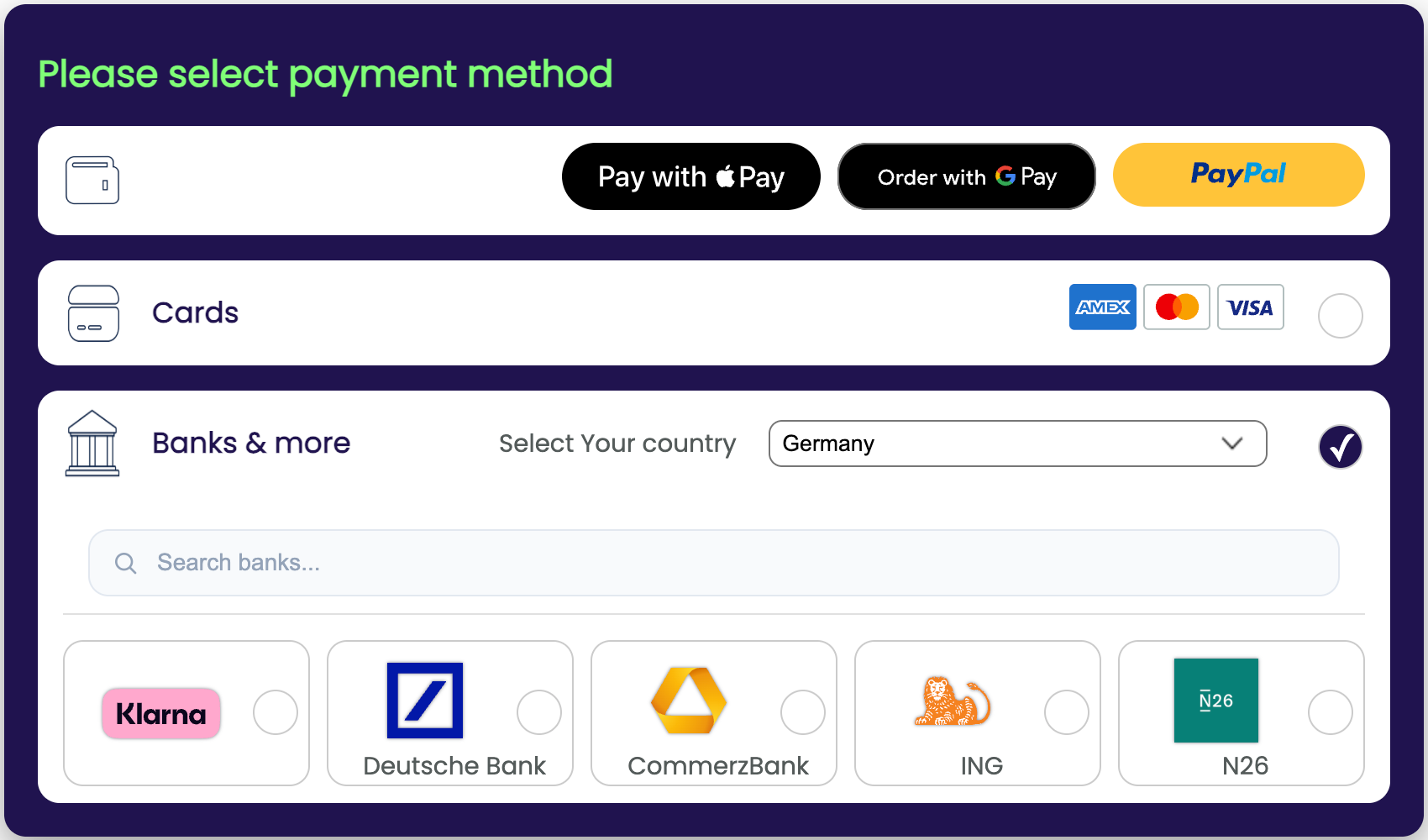
How Maksu helps you accept payment methods across Europe
Every method in this guide used to mean a separate contract, a separate integration, and a separate report. Maksu replaces that with one.
One integration, 70+ payment methods. Cards, wallets, and Klarna run on Maksu’s own direct integrations. Local methods such as iDEAL | Wero, Bancontact, eps (Electronic Payment Standard), Twint and SEPA Direct Debit come through the same connection. When a scheme changes, as iDEAL is doing now, you don’t rebuild anything.
Bank payments built in. Bankpay+ is Maksu’s pay-by-bank product, based on Instant SEPA. The money reaches you in seconds, and no card chargebacks apply.
Go live your way. Use the hosted payment page, connect through the API, or install a plugin for WooCommerce, PrestaShop, Wix, or Shopware. Maksu also integrates with Zoho Books. You add methods without a new checkout build.
Security from the people who know 3-D Secure. Maksu was built by Modirum, which has worked on 3-D Secure technology for more than 25 years. The platform is PCI DSS 4.0.1 compliant and includes 3-D Secure, network tokenisation and a risk engine.
Fast start, real people. Onboarding is quick: KYC/KYB verification is completed within 24 hours. You get a dedicated Customer Success Manager and 24/7 online support during and after integration.
Built for repeat business. Maksu supports recurring payments for SaaS and subscription models, with fast reconciliation and settlement.
In short: you choose the markets, and Maksu brings the methods your shoppers expect there.
Talk to our team about your checkout mix →
Key takeaways
- UK: Digital wallets lead with 40% of online spend, and cards still carry 46% (Worldpay, 2025 data). Cover Visa, Mastercard, Apple Pay, Google Pay and Paypal first.
- DACH: Germany runs on Paypal, invoice, and direct debit. Austria adds eps (Electronic Payment Standard). Switzerland pays with Twint, in Swiss francs.
- Benelux: iDEAL carries 64% of Dutch online payment value and becomes Wero by the end of 2027. Belgium expects Bancontact.
- The shift: Wallets and bank payments keep taking share from cards. Giropay and Sofort are gone, and Payconiq has closed in Luxembourg.
- The fix: You don’t need a contract per method. One Maksu integration covers cards, wallets and local methods across all three regions.
FAQ
What are the most popular online payment methods in Europe?
It depends on the country. Digital wallets and cards lead in the UK. Paypal, invoice, and direct debit lead in Germany. iDEAL leads in the Netherlands, Bancontact in Belgium, eps (Electronic Payment Standard) in Austria, and Twint in Switzerland. Cards, Paypal, Apple Pay and Google Pay are the only methods that work across all of them.
What payment methods are used in the UK?
UK shoppers pay online with digital wallets (40% of online spend in 2025) and with credit and debit cards (46%), according to Worldpay. Paypal, Apple Pay and Google Pay are the main wallets. Klarna and Clearpay cover pay-later, and open banking payments are growing fast from a small base.
What is the most popular payment method in Germany?
Paypal. Seven in ten German online shoppers use it, according to the Worldpay Global Payments Report 2026. Purchase on invoice (Kauf auf Rechnung) and SEPA Direct Debit (Lastschrift) are available. Credit cards play a smaller role in Germany than in most European markets, so a card-only checkout loses sales there.
Is iDEAL being replaced by Wero?
Yes. Since early 2026, Dutch checkouts show a co-branded iDEAL | Wero logo. Payments move to the Wero infrastructure from late 2026, and the migration should finish by 31 December 2027. After that, the iDEAL name disappears. Merchants stay with their current payment provider through the change.
Are Sofort and Giropay still available?
No. Giropay shut down on 31 December 2024. Sofort no longer exists as a standalone method because Klarna folded it into its own checkout. If you still show either logo, remove it. Wero, pay by bank, and SEPA Direct Debit are the closest replacements for German and Austrian shoppers.
What is pay by bank?
Pay by bank is an account-to-account payment. The shopper approves a transfer in their own banking app, and the money goes straight to the merchant. In the euro area, it runs on Instant SEPA and arrives within ten seconds. No card network is involved, so costs are lower, and card chargebacks don’t apply.
Which payment methods support subscriptions?
Cards and card-based wallets handle recurring payments in every market. SEPA Direct Debit is the classic choice for subscriptions in the euro area. Several local methods, including iDEAL, Bancontact and Twint, can support repeat payments too. Wero is adding subscriptions, with Germany first. Always confirm the details with your provider.
How many payment methods should an online shop offer?
As a rule of thumb, four to six per country: cards, one or two wallets, the leading local method, and a bank payment. Add pay-later if your basket size supports it. Show each shopper only the methods that fit their country, so the list stays short and familiar.
Ready to fix your checkout mix?
Your shoppers already know how they want to pay. Give them that option, in every market, with one integration.
Talk to our team about your checkout mix →
Sources
Data as of November 2026.
- Worldpay Global Payments Report 2026 (2025 data): UK, Germany, Netherlands and Belgium ecommerce shares, global wallet share
- European Payments Initiative, 16 July 2026: iDEAL to Wero migration roadmap and pricing
- Wero, iDEAL to Wero transition: transition phases
- European Payments Initiative, key figures: Wero rollout by country
- European Payments Initiative, 24 July 2026: Wero user numbers
- Wero, 17 November 2025: Wero ecommerce launch in Germany
- Erste Group, 22 June 2026: Austrian banks join EPI
- European Central Bank, Instant Payments Regulation: implementation deadlines
- Twint, 2026 press release: users, transactions and acceptance
- Open Banking Limited: UK open banking payment volumes, June 2026
- Bancontact Company, 6 November 2025: Bancontact Pay rebrand and figures
- BIL, Wero arrives in Luxembourg: Payconiq end date in Luxembourg
- Mastercard, Maestro retirement: Maestro phase-out
- Wikipedia, Giropay: Giropay phase-out
- Klarna AB (publ), Klarna and SOFORT join forces: Klarna acquires Sofort
About Maksu
Maksu is a European online payments provider helping micro, small, and medium-sized merchants grow through simple, secure, and affordable online payments. While focusing on supporting SMBs, Maksu also delivers customizable enterprise solutions tailored to complex business needs. Built on Modirum’s 25-year legacy in FinTech and payment technology, Maksu empowers online businesses and e-shops to maximize conversions and eliminate payment friction through a seamless payment experience.
As a Payment Institution, licensed by the Austrian Financial Market Authority (FMA), Maksu delivers regulated payment services across Europe and worldwide. With headquarters in Vienna and operations in London and the UK, Maksu’s mission is to make advanced cross-border payment capabilities easier, fairer, and more accessible for every business, from emerging e-shops to established international brands. More info at www.maksupay.com
You can also read
Online Payment Methods in Europe: Merchant Guide | Maksu
Maksu is heading to SiGMA World Rome 2026
The Robin Hood of payments? Why Maksu is betting on Europe’s forgotten merchants

5 Questions every merchant should ask when choosing a payment processor
Maksu expands its portfolio with BANKpay+, bringing built-in, Account-to-Account Payments to European Merchants